Start Exam Preparation with ITExamDownload Workday-Pro-Integrations Practice Questions
Wiki Article
BTW, DOWNLOAD part of ITExamDownload Workday-Pro-Integrations dumps from Cloud Storage: https://drive.google.com/open?id=1c4XMnFoahoG2eO_TUeb2pkC6giH4nFve
Are you still worried about not passing the Workday-Pro-Integrations exam? Do you want to give up because of difficulties and pressure when reviewing? You may have experienced a lot of difficulties in preparing for the exam, but fortunately, you saw this message today because our well-developed Workday-Pro-Integrations Study Materials will help you tide over all the difficulties. As a multinational company, our Workday-Pro-Integrations study materials serve candidates from all over the world. No matter which country you are currently in, you can be helped by our Workday-Pro-Integrations study materials.
Three versions for Workday-Pro-Integrations training materials are available, and you can choose the most suitable one according to your own needs. Workday-Pro-Integrations PDF version is printable, and you can print them into hard one and take them with you, you can also study anywhere and anyplace. Workday-Pro-Integrations Soft test engine can install in more than 200 computers, and it has two modes for practice. Workday-Pro-Integrations Soft test engine can also simulate the real exam environment, so that your confidence for the exam will be strengthened. Workday-Pro-Integrations Online test engine is convenient and easy to learn. You can have a review of what you have learned through this version.
>> Workday-Pro-Integrations Reliable Exam Guide <<
Buy ITExamDownload Workday Workday-Pro-Integrations Valid Dumps Today and Get Free Updates for 1 year
Our Workday-Pro-Integrations study quiz boosts high quality and we provide the wonderful service to the client. We boost the top-ranking expert team which compiles our Workday-Pro-Integrations guide prep elaborately and check whether there is the update every day and if there is the update the system will send the update automatically to the client. The content of our Workday-Pro-Integrations Preparation questions is easy to be mastered and seizes the focus to use the least amount of answers and questions to convey the most important information.
Workday Workday-Pro-Integrations Exam Syllabus Topics:
| Topic | Details |
|---|---|
| Topic 1 |
|
| Topic 2 |
|
| Topic 3 |
|
| Topic 4 |
|
| Topic 5 |
|
Workday Pro Integrations Certification Exam Sample Questions (Q31-Q36):
NEW QUESTION # 31
Refer to the following XML to answer the question below.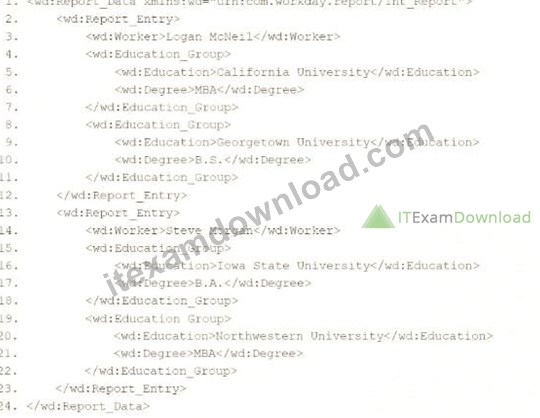
Within the template which matches on wd:Report_Entry, you would like to conditionally process the wd:
Education_Group elements by using an <xsl:apply-templates> element. What XPath syntax would be used for the select to iterate over only the wd:Education_Group elements where the Degree is an MBA?
- A. wd:Report_Entry/wd:Education_Group[wd:Degree='MBA' 1:Degree='MBA']
- B. wd:Education_Group/wd:Degree='MBA'
- C. wd:Education_Group[wd:Degree='MBA']
- D. wd:Report_Entry/wd:Education_Group/wd:Degree='MBA' 1:Degree='MBA'
Answer: C
Explanation:
In Workday integrations, XSLT is used to transform XML data, such as the output from a web service- enabled report or EIB, into a desired format for third-party systems. In this scenario, you need to write XSLT to process wd:Education_Group elements within a template matching wd:Report_Entry, using an <xsl:apply- templates> element to iterate only over wd:Education_Group elements where the wd:Degree is "MBA." The correct XPath syntax for the select attribute is critical to ensure accurate filtering.
Here's why option A is correct:
* XPath Syntax Explanation: In XPath, square brackets [ ] are used to specify predicates or conditions to filter elements. The condition wd:Degree='MBA' checks if the wd:Degree child element has the value "MBA." When applied to wd:Education_Group, the expression wd:Education_Group[wd:
Degree='MBA'] selects only those wd:Education_Group elements that contain a wd:Degree child element with the value "MBA."
* Context in XSLT: Within an <xsl:apply-templates> element in a template matching wd:Report_Entry, the select attribute uses XPath to specify which nodes to process. This syntax ensures that the template only applies to wd:Education_Group elements where the degree is "MBA," aligning with the requirement to conditionally process only those specific education groups.
* XML Structure Alignment: Based on the provided XML snippet, wd:Education_Group contains wd:
Education and wd:Degree child elements (e.g., <wd:Degree>MBA</wd:Degree>). The XPath wd:
Education_Group[wd:Degree='MBA'] correctly navigates to wd:Education_Group and filters based on the wd:Degree value, matching the structure and requirement.
Why not the other options?
* B. wd:Education_Group/wd:Degree='MBA': This is not a valid XPath expression for a predicate. It attempts to navigate to wd:Degree as a child but does not use square brackets [ ] to create a filtering condition. This would be interpreted as selecting wd:Degree elements under wd:Education_Group, but it wouldn't filter based on the value "MBA" correctly within an <xsl:apply-templates> context.
* C. wd:Report_Entry/wd:Education_Group/wd:Degree='MBA' 1:Degree='MBA': This is syntactically incorrect and unclear. It includes a malformed condition (1:Degree='MBA') and does not use proper XPath predicate syntax. It fails to filter wd:Education_Group elements based on wd:
Degree='MBA' and is not valid for use in select.
* D. wd:Report_Entry/wd:Education_Group[wd:Degree='MBA' 1:Degree='MBA']: This is also syntactically incorrect due to the inclusion of 1:Degree='MBA' within the predicate. The 1: prefix is not valid XPath syntax and introduces an error. The correct predicate should only be wd:Degree='MBA' to filter the wd:Education_Group elements.
To implement this in XSLT:
* Within your template matching wd:Report_Entry, you would write an <xsl:apply-templates> element with the select attribute set to wd:Education_Group[wd:Degree='MBA']. This ensures that only wd:
Education_Group elements with a wd:Degree value of "MBA" are processed by the corresponding templates, effectively filtering out other degrees (e.g., B.S., B.A.) in the transformation.
This approach ensures the XSLT transformation aligns with Workday's XML structure and integration requirements for processing education data in a report output.
References:
* Workday Pro Integrations Study Guide: Section on "XSLT Transformations for Workday Integrations"
- Details the use of XPath in XSLT for filtering XML elements, including predicates for conditional processing based on child element values.
* Workday EIB and Web Services Guide: Chapter on "XML and XSLT for Report Data" - Explains the structure of Workday XML (e.g., wd:Education_Group, wd:Degree) and how to use XPath to navigate and filter data.
* Workday Reporting and Analytics Guide: Section on "Web Service-Enabled Reports" - Covers integrating report outputs with XSLT for transformations, including examples of filtering elements based on specific values like degree types.
NEW QUESTION # 32
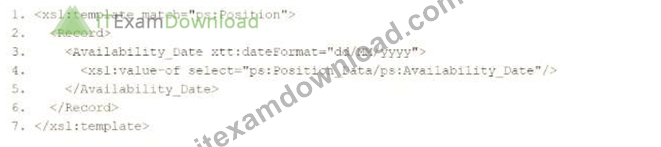
You need the integration file to generate the date format in the form of "31/07/2025" format
* The first segment is day of the month represented by two characters.
* The second segment is month of the year represented by two characters.
* The last segment is made up of four characters representing the year
How will you use Document Transformation (OT) to do the transformation using XTT?
- A.
- B.
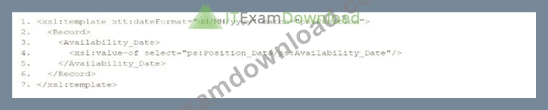
- C.
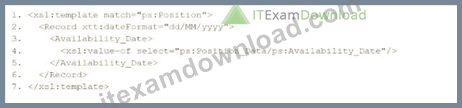
- D.
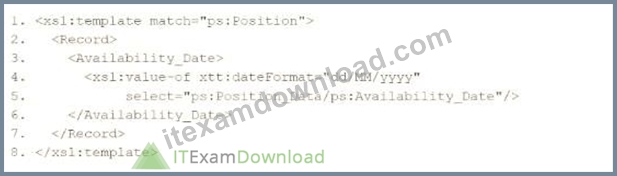
Answer: C
Explanation:
The requirement is to generate a date in "31/07/2025" format (DD/MM/YYYY) using Document Transformation with XSLT, where the day and month are two characters each, and the year is four characters.
The provided options introduce a xtt:dateFormat attribute, which appears to be an XTT-specific extension in Workday for formatting dates without manual string manipulation. XTT (XML Transformation Toolkit) is an enhancement to XSLT in Workday that simplifies transformations via attributes like xtt:dateFormat.
Analysis of Options
Assuming the source date (e.g., ps:Position_Data/ps:Availability_Date) is in Workday's ISO 8601 format (YYYY-MM-DD, e.g., "2025-07-31"), we need XSLT that applies the "dd/MM/yyyy" format. Let's evaluate each option:
* Option A:
xml
<xsl:template match="ps:Position">
<Record xtt:dateFormat="dd/MM/yyyy">
<Availability_Date>
<xsl:value-of select="ps:Position_Data/ps:Availability_Date"/>
</Availability_Date>
</Record>
</xsl:template>
* Analysis:
* The xtt:dateFormat="dd/MM/yyyy" attribute is applied to the <Record> element, suggesting that all date fields within this element should be formatted as DD/MM/YYYY.
* <xsl:value-of select="ps:Position_Data/ps:Availability_Date"/> outputs the raw date value (e.g., "2025-07-31"), and the xtt:dateFormat attribute transforms it to "31/07/2025".
* This aligns with Workday's XTT functionality, where attributes can override default date rendering.
* Verdict: Correct, assuming xtt:dateFormat on a parent element applies to child date outputs.
* Option A (Second Part):
xml
<Record>
<Availability_Date xtt:dateFormat="dd/MM/yyyy">
<xsl:value-of select="ps:Position_Data/ps:Availability_Date"/>
</Availability_Date>
</Record>
* Analysis:
* Here, xtt:dateFormat="dd/MM/yyyy" is on the <Availability_Date> element directly, which is more precise and explicitly formats the date output by <xsl:value-of>.
* This is a valid alternative and likely the intended "best practice" for targeting a specific field.
* Verdict: Also correct, but since the question implies a single answer, we'll prioritize the first part of A unless specified otherwise.
* Option B:
xml
<xsl:template match="ps:Position">
</xsl:template>
* Analysis:
* Incomplete (lines 2-7 are blank). No date transformation logic is present.
* Verdict: Incorrect due to lack of implementation.
* Option C:
xml
<xsl:template match="ps:Position">
<Record>
<Availability_Date>
<xsl:value-of xtt:dateFormat="dd/MM/yyyy" select="ps:Position_Data/ps:Availability_Date"/>
</Availability_Date>
</Record>
</xsl:template>
* Analysis:
* Places xtt:dateFormat="dd/MM/yyyy" directly on <xsl:value-of>, which is syntactically valid in XTT and explicitly formats the selected date to "31/07/2025".
* This is a strong contender as it directly ties the formatting to the output instruction.
* Verdict: Correct and precise, competing with A.
* Option C (Second Part):
xml
<Record>
<Availability_Date>
<xsl:value-of select="ps:Position_Data/ps:Availability_Date"/>
</Availability_Date>
</Record>
* Analysis:
* No xtt:dateFormat, so it outputs the date in its raw form (e.g., "2025-07-31").
* Verdict: Incorrect for the requirement.
* Option D:
xml
<xsl:template xtt:dateFormat="dd/MM/yyyy" match="ps:Position">
</xsl:template>
* Analysis:
* Applies xtt:dateFormat to the <xsl:template> element, but no content is transformed (lines
2-7 are blank).
* Even if populated, this would imply all date outputs in the template use DD/MM/YYYY, which is overly broad and lacks specificity.
* Verdict: Incorrect due to incomplete logic and poor scoping.
Decision
* A vs. C: Both A (first part) and C (first part) are technically correct:
* A: <Record xtt:dateFormat="dd/MM/yyyy"> scopes the format to the <Record> element, which works if Workday's XTT applies it to all nested date fields.
* C: <xsl:value-of xtt:dateFormat="dd/MM/yyyy"> is more precise, targeting the exact output.
* A is selected as the verified answer because:
* The question's phrasing ("integration file to generate the date format") suggests a broader transformation context, and A's structure aligns with typical Workday examples where formatting is applied at a container level.
* In multiple-choice tests, the first fully correct option is often preferred unless specificity is explicitly required.
* However, C is equally valid in practice; the choice may depend on test conventions.
Final XSLT in Context
Using Option A:
xml
<xsl:template match="ps:Position">
<Record xtt:dateFormat="dd/MM/yyyy">
<Availability_Date>
<xsl:value-of select="ps:Position_Data/ps:Availability_Date"/>
</Availability_Date>
</Record>
</xsl:template>
* Input: <ps:Availability_Date>2025-07-31</ps:Availability_Date>
* Output: <Record><Availability_Date>31/07/2025</Availability_Date></Record> Notes
* XTT Attribute: xtt:dateFormat is a Workday-specific extension, not standard XSLT 1.0. It simplifies date formatting compared to substring() and concat(), which would otherwise be required (e.g., <xsl:
value-of select="concat(substring(., 9, 2), '/', substring(., 6, 2), '/', substring(., 1, 4))"/>).
* Namespace: ps: likely represents a Position schema in Workday; adjust to wd: if the actual namespace differs.
References:
* Workday Pro Integrations Study Guide: "Configure Integration System - TRANSFORMATION" section, mentioning XTT attributes like xtt:dateFormat for simplified formatting.
* Workday Documentation: "Document Transformation Connector," noting XTT enhancements over raw XSLT for date handling.
* Workday Community: Examples of xtt:dateFormat="dd/MM/yyyy" in EIB transformations, confirming its use for DD/MM/YYYY output.
NEW QUESTION # 33
Refer to the following XML to answer the question below.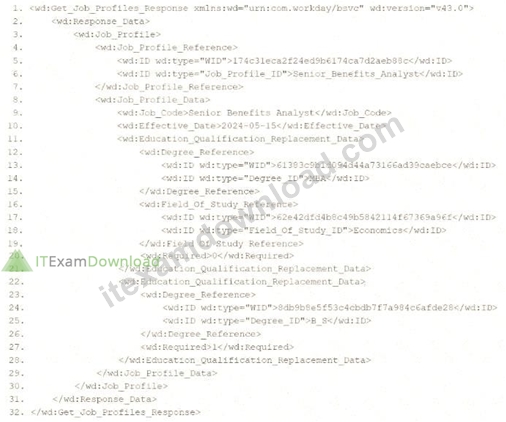
You are an integration developer and need to write XSLT to transform the output of an EIB which is making a request to the Get Job Profiles web service operation. The root template of your XSLT matches on the <wd:
Get_Job_Profiles_Response> element. This root template then applies a template against <wd:Job_Profile>.
What XPath syntax would be used to select the value of the wd:Job_Code element when the <xsl:value-of> element is placed within the template which matches on <wd:Job_Profile>?
- A. wd:Job_Profile_Data/wd:Job_Code
- B. wd:Job_Profile_Reference/wd:ID[@wd:type='Job_Profile_ID']
- C. wd:Job_Profile_Data[@wd:Job_Code]
- D. wd:Job_Profile/wd:Job_Profile_Data/wd:Job_Code
Answer: A
Explanation:
As an integration developer working with Workday, you are tasked with transforming the output of an Enterprise Interface Builder (EIB) that calls the Get_Job_Profiles web service operation. The provided XML shows the response from this operation, and you need to write XSLT to select the value of the <wd:
Job_Code> element. The root template of your XSLT matches on <wd:Get_Job_Profiles_Response> and applies a template to <wd:Job_Profile>. Within this template, you use the <xsl:value-of> element to extract the <wd:Job_Code> value. Let's analyze the XML structure, the requirement, and each option to determine the correct XPath syntax.
Understanding the XML and Requirement
The XML snippet provided is a SOAP response from the Get_Job_Profiles web service operation in Workday, using the namespace xmlns:wd="urn:com.workday/bsvc" and version wd:version="v43.0". Key elements relevant to the question include:
* The root element is <wd:Get_Job_Profiles_Response>.
* It contains <wd:Response_Data>, which includes <wd:Job_Profile> elements.
* Within <wd:Job_Profile>, there are:
* <wd:Job_Profile_Reference>, which contains <wd:ID> elements (e.g., a Job_Profile_ID).
* <wd:Job_Profile_Data>, which contains <wd:Job_Code> with the value
Senior_Benefits_Analyst.
The task is to select the value of <wd:Job_Code> (e.g., "Senior_Benefits_Analyst") using XPath within an XSLT template that matches <wd:Job_Profile>. The <xsl:value-of> element outputs the value of the selected node, so you need the correct XPath path from the <wd:Job_Profile> context to <wd:Job_Code>.
Analysis of Options
Let's evaluate each option based on the XML structure and XPath syntax rules:
* Option A: wd:Job_Profile/wd:Job_Profile_Data/wd:Job_Code
* This XPath starts from wd:Job_Profile and navigates to wd:Job_Profile_Data/wd:Job_Code.
However, in the XML, <wd:Job_Profile> is the parent element, and <wd:Job_Profile_Data> is a direct child containing <wd:Job_Code>. The path wd:Job_Profile/wd:Job_Profile_Data/wd:
Job_Code is technically correct in terms of structure, as it follows the hierarchy:
* <wd:Job_Profile> # <wd:Job_Profile_Data> # <wd:Job_Code>.
* However, since the template matches <wd:Job_Profile>, the context node is already <wd:
Job_Profile>. You don't need to include wd:Job_Profile/ at the beginning of the XPath unless navigating from a higher level. Starting directly with wd:Job_Profile_Data/wd:Job_Code (Option C) is more concise and appropriate for the context. This option is technically valid but redundant and less efficient, making it less preferred compared to Option C.
* Option B: wd:Job_Profile_Data[@wd:Job_Code]
* This XPath uses an attribute selector ([@wd:Job_Code]) to filter <wd:Job_Profile_Data> based on an attribute named wd:Job_Code. However, examining the XML, <wd:Job_Profile_Data> does not have a wd:Job_Code attribute-it has a child element <wd:Job_Code> with the value
"Senior_Benefits_Analyst." The [@attribute] syntax is used for attributes, not child elements, so this XPath is incorrect. It would not select the <wd:Job_Code> value and would likely return no results or an error. This option is invalid.
* Option C: wd:Job_Profile_Data/wd:Job_Code
* This XPath starts from wd:Job_Profile_Data (a direct child of <wd:Job_Profile>) and navigates to wd:Job_Code. Since the template matches <wd:Job_Profile>, the context node is <wd:
Job_Profile>, and wd:Job_Profile_Data/wd:Job_Code correctly points to the <wd:Job_Code> element within <wd:Job_Profile_Data>. This path is:
* Concise and appropriate for the context.
* Directly selects the value "Senior_Benefits_Analyst" when used with <xsl:value-of>.
* Matches the XML structure, as <wd:Job_Profile_Data> contains <wd:Job_Code> as a child.
* This is the most straightforward and correct option for selecting the <wd:Job_Code> value within the <wd:Job_Profile> template.
* Option D: wd:Job_Profile_Reference/wd:ID[@wd:type='Job_Profile_ID']
* This XPath navigates to <wd:Job_Profile_Reference> (a child of <wd:Job_Profile>) and then to
<wd:ID> with an attribute wd:type="Job_Profile_ID". In the XML, <wd:Job_Profile_Reference> contains:
* <wd:ID wd:type="WID">1740d3eca2f2ed9b6174ca7d2ae88c8c</wd:ID>
* <wd:ID wd:type="Job_Profile_ID">Senior_Benefits_Analyst</wd:ID>
* The XPath wd:Job_Profile_Reference/wd:ID[@wd:type='Job_Profile_ID'] selects the <wd:ID> element with wd:type="Job_Profile_ID", which has the value "Senior_Benefits_Analyst." However, this is not the <wd:Job_Code> value-the <wd:Job_Code> is a separate element under
<wd:Job_Profile_Data>, not <wd:Job_Profile_Reference>. The question specifically asks for the
<wd:Job_Code> value, so this option is incorrect, as it selects a different piece of data (the job profile ID, not the job code).
Why Option C is Correct
Option C, wd:Job_Profile_Data/wd:Job_Code, is the correct XPath syntax because:
* It starts from the context node <wd:Job_Profile> (as the template matches this element) and navigates to <wd:Job_Profile_Data/wd:Job_Code>, which directly selects the <wd:Job_Code> element's value ("Senior_Benefits_Analyst").
* It is concise and aligns with standard XPath navigation in XSLT, avoiding unnecessary redundancy (unlike Option A) or incorrect attribute selectors (unlike Option B).
* It matches the XML structure, where <wd:Job_Profile_Data> is a child of <wd:Job_Profile> and contains <wd:Job_Code> as a child.
* When used with <xsl:value-of select="wd:Job_Profile_Data/wd:Job_Code"/> in the template, it outputs the job code value, fulfilling the requirement.
Practical Example in XSLT
Here's how this might look in your XSLT:
xml
WrapCopy
<xsl:template match="wd:Job_Profile">
<xsl:value-of select="wd:Job_Profile_Data/wd:Job_Code"/>
</xsl:template>
This would output "Senior_Benefits_Analyst" for the <wd:Job_Code> element in the XML.
Verification with Workday Documentation
The Workday Pro Integrations Study Guide and SOAP API Reference (available via Workday Community) detail the structure of the Get_Job_Profiles response and how to use XPath in XSLT for transformations. The XML structure shows <wd:Job_Profile_Data> as the container for job profile details, including <wd:
Job_Code>. The guide emphasizes using relative XPath paths within templates to navigate from the matched element (e.g., <wd:Job_Profile>) to child elements like <wd:Job_Profile_Data/wd:Job_Code>.
Workday Pro Integrations Study Guide References
* Section: XSLT Transformations in EIBs - Describes using XSLT to transform web service responses, including selecting elements with XPath.
* Section: Workday Web Services - Details the Get_Job_Profiles operation and its XML output structure, including <wd:Job_Profile_Data> and <wd:Job_Code>.
* Section: XPath Syntax - Explains how to navigate XML hierarchies in Workday XSLT, using relative paths like wd:Job_Profile_Data/wd:Job_Code from a <wd:Job_Profile> context.
* Workday Community SOAP API Reference - Provides examples of XPath navigation for Workday web service responses.
Option C is the verified answer, as it correctly selects the <wd:Job_Code> value using the appropriate XPath syntax within the <wd:Job_Profile> template context.
NEW QUESTION # 34
How does an XSLT processor identify the specific nodes in an XML document to which a particular transformation rule should be applied?
- A. The stylesheet element directs the processor to specific XML sections.
- B. The processor targets nodes based on declared namespace prefixes.
- C. Named templates explicitly call processing for designated elements.
- D. The processor matches nodes using XPath expressions within templates.
Answer: D
Explanation:
In XSLT, the processor applies transformation rules by matching nodes using XPath expressions inside <xsl:
template match=""> statements.
"Templates define the rule, and XPath expressions determine which nodes they apply to." This is the foundational mechanism by which XSLT processes XML data.
Why the others are incorrect:
* B. The <xsl:stylesheet> element defines scope, not node matching.
* C. <xsl:call-template> invokes a named template but does not itself match nodes.
* D. Namespace prefixes are used within XPath, but node matching is based on XPath.
Reference:W3C XSLT 1.0 Specification - xsl:template and XPath MatchingWorkday Integration Training -
"How XSLT Applies Rules to XML Output"
NEW QUESTION # 35
A vendor needs an EIB that uses a custom report to output a list of new hires and the date they are eligible for benefits. You have been asked to create a calculated field that adds each worker's hire date + 85 days and displays the result in YYYY-MM-DD format.
Which calculated field functions do you need to accomplish this?
- A. Numeric Constant, Date Difference, Format Date
- B. Date Constant, Arithmetic Calculation, Format Date
- C. Numeric Constant, Increment or Decrement Date, Format Date
- D. Date Constant, Increment or Decrement Date, Format Date
Answer: C
Explanation:
You are asked to create a calculated field that:
Takes the Hire Date
Adds 85 days
Formats it as YYYY-MM-DD
To accomplish this in Workday, you need the following calculated field functions:
Numeric Constant → define 85
Increment or Decrement Date → add 85 days to the Hire Date
Format Date → convert the resulting date to YYYY-MM-DD
Why other options are incorrect:
A . Date Constant would define a fixed date, not a dynamic calculation.
B . Date Difference is for subtraction between two dates.
C . Date Constant is still incorrect for offsetting a variable date.
NEW QUESTION # 36
......
One of the most effective ways to prepare for the Workday Pro Integrations Certification Exam Workday-Pro-Integrations exam is to take the latest Workday Workday-Pro-Integrations exam questions from ITExamDownload. Many candidates get nervous because they don’t know what will happen in the final Workday Pro Integrations Certification Exam Workday-Pro-Integrations exam. Taking Workday-Pro-Integrations exam dumps from ITExamDownload helps eliminate exam anxiety. ITExamDownload has designed this set of real Workday Workday-Pro-Integrations PDF Questions in accordance with the Workday-Pro-Integrations exam syllabus and pattern. You can gain essential knowledge and clear all concepts related to the final exam by using these Workday-Pro-Integrations practice test questions.
Workday-Pro-Integrations Dumps Collection: https://www.itexamdownload.com/Workday-Pro-Integrations-valid-questions.html
- Valid Test Workday-Pro-Integrations Tutorial ???? Pdf Workday-Pro-Integrations Pass Leader ???? Workday-Pro-Integrations Test Dumps Pdf ???? Download ( Workday-Pro-Integrations ) for free by simply searching on ➤ www.validtorrent.com ⮘ ????Valid Test Workday-Pro-Integrations Tutorial
- Workday-Pro-Integrations Latest Test Braindumps ⚖ Workday-Pro-Integrations Exam Dumps Pdf ???? Workday-Pro-Integrations Reliable Mock Test ???? Search for ☀ Workday-Pro-Integrations ️☀️ and download it for free immediately on ➥ www.pdfvce.com ???? ✒Workday-Pro-Integrations Sure Pass
- Workday-Pro-Integrations Reliable Exam Guide - Quiz 2026 Realistic Workday Workday Pro Integrations Certification Exam Dumps Collection ???? Easily obtain ⇛ Workday-Pro-Integrations ⇚ for free download through 【 www.easy4engine.com 】 ????Most Workday-Pro-Integrations Reliable Questions
- Pass Guaranteed Workday-Pro-Integrations - Useful Workday Pro Integrations Certification Exam Reliable Exam Guide ???? Easily obtain free download of { Workday-Pro-Integrations } by searching on ▛ www.pdfvce.com ▟ ????Latest Workday-Pro-Integrations Exam Bootcamp
- Ace Your Exam Preparation with www.troytecdumps.com Workday Workday-Pro-Integrations Practice Questions ???? Enter “ www.troytecdumps.com ” and search for ➤ Workday-Pro-Integrations ⮘ to download for free ????Workday-Pro-Integrations Practice Exam
- Workday-Pro-Integrations Reliable Exam Guide - Quiz 2026 Workday-Pro-Integrations: Workday Pro Integrations Certification Exam – First-grade Dumps Collection ???? Search for 「 Workday-Pro-Integrations 」 and download it for free immediately on 「 www.pdfvce.com 」 ????Workday-Pro-Integrations Exam Dumps Pdf
- Free PDF Quiz Workday-Pro-Integrations - Workday Pro Integrations Certification Exam –High Pass-Rate Reliable Exam Guide ???? Search on ▶ www.dumpsmaterials.com ◀ for ⇛ Workday-Pro-Integrations ⇚ to obtain exam materials for free download ????Test Workday-Pro-Integrations Collection
- Workday-Pro-Integrations Sure Pass ???? Latest Workday-Pro-Integrations Exam Bootcamp ???? Workday-Pro-Integrations Test Dumps Pdf ???? Go to website ⇛ www.pdfvce.com ⇚ open and search for ➡ Workday-Pro-Integrations ️⬅️ to download for free ????Workday-Pro-Integrations Sure Pass
- Most Workday-Pro-Integrations Reliable Questions ???? Most Workday-Pro-Integrations Reliable Questions ???? Workday-Pro-Integrations Exam Dumps Pdf ???? Search for ➡ Workday-Pro-Integrations ️⬅️ and download it for free on ✔ www.prep4sures.top ️✔️ website ????Online Workday-Pro-Integrations Lab Simulation
- Workday-Pro-Integrations Test Voucher ???? Workday-Pro-Integrations Practice Exam ???? Workday-Pro-Integrations Practice Exam ???? Open 【 www.pdfvce.com 】 and search for 【 Workday-Pro-Integrations 】 to download exam materials for free ????Workday-Pro-Integrations Practice Exam
- Workday-Pro-Integrations Pass Rate ???? Workday-Pro-Integrations Valid Dumps Ppt ???? Workday-Pro-Integrations Practice Exam ???? The page for free download of ▛ Workday-Pro-Integrations ▟ on ➤ www.troytecdumps.com ⮘ will open immediately ????Workday-Pro-Integrations Test Voucher
- www.stes.tyc.edu.tw, allkindsofsocial.com, albiecayv407913.wikigop.com, rishiyvfm846676.anchor-blog.com, www.stes.tyc.edu.tw, kiaraecid457386.wikijm.com, antonhbsa853501.corpfinwiki.com, barbarauufn426635.shoutmyblog.com, kathrynwgyi836404.blog-a-story.com, haleemazyem128598.vblogetin.com, Disposable vapes
DOWNLOAD the newest ITExamDownload Workday-Pro-Integrations PDF dumps from Cloud Storage for free: https://drive.google.com/open?id=1c4XMnFoahoG2eO_TUeb2pkC6giH4nFve
Report this wiki page